

How to Buy Multifamily Property in 2026 (Quick Guide)
Want to buy multifamily property? This guide walks you through financing, finding deals, and making smart offers in today's market.
Thinking about jumping into rental property? Smart move. When you buy multifamily property, you're not just getting one tenant. You're getting multiple income streams under one roof. That means less risk and more cash flow. But the process is different from buying a single-family home. Let me walk you through what you need to know.
Why Multifamily Properties Make Sense Right Now
The rental market in Indiana is hot. People need places to live.
When you buy multifamily property, you spread your risk across multiple units. One vacancy doesn't kill your income. You've still got other tenants paying rent.
The math works better than single-family homes. Here's why:
- Lower per-unit costs for maintenance
- One roof covers multiple income sources
- Easier to scale your portfolio
- Banks see them as lower risk
Plus, you can live in one unit and rent the others. That's called house hacking. Your tenants basically pay your mortgage.
The Real Numbers You Need to Know
Let's talk actual dollars. Not theory.
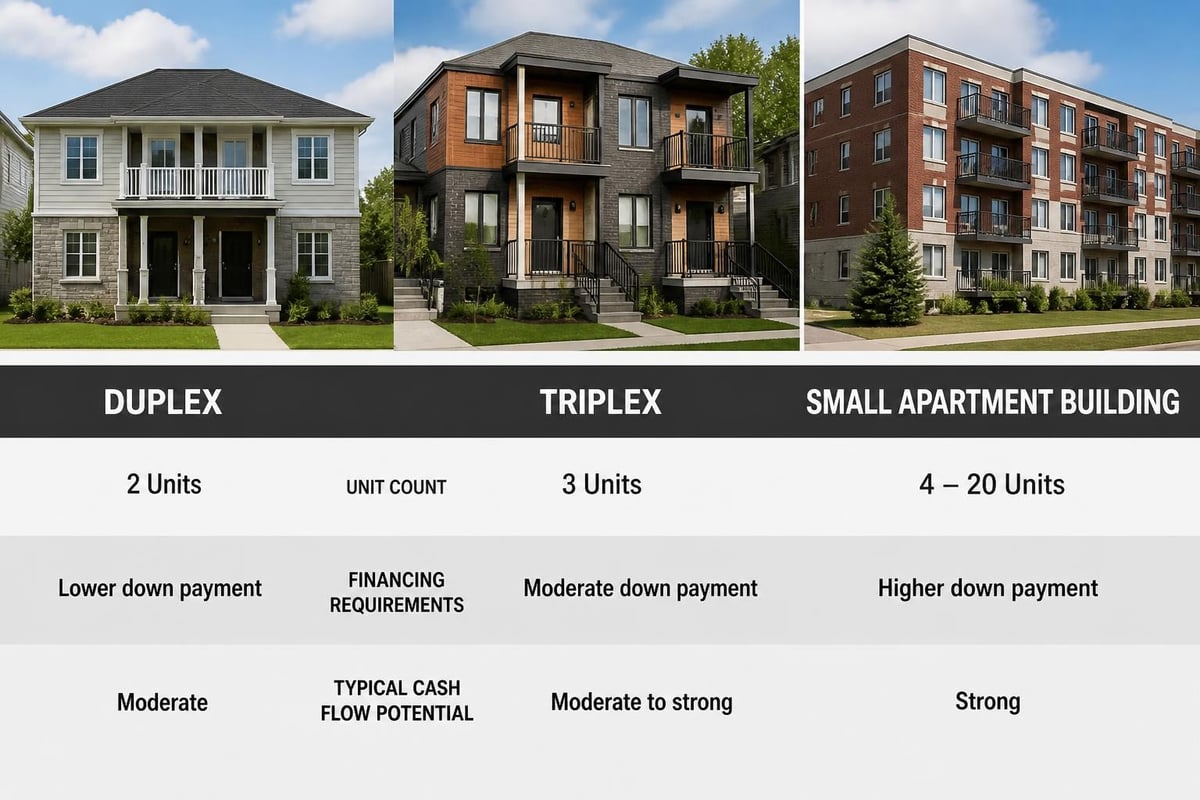
| Property Type | Typical Down Payment | Financing Options | Monthly Management Time |
|---|---|---|---|
| Duplex | 15-25% | FHA, Conventional, Commercial | 5-10 hours |
| Triplex/Fourplex | 20-25% | Conventional, Commercial | 10-15 hours |
| 5+ Units | 25-30% | Commercial only | 15-20+ hours |
The sweet spot for most new investors? A duplex or triplex. Small enough to manage. Big enough to make money.
Finding the Right Multifamily Property
Location beats everything else. Period.
Look for areas near jobs, schools, and transit. That's where tenants want to live. That's where rent stays stable.
Start with these hunting grounds:
- Neighborhoods seeing new development
- Areas near universities (consistent tenant demand)
- Communities with growing job markets
- Places where single-family homes cost too much
Drive the neighborhoods. Talk to local property managers. They know which buildings are struggling and which landlords might sell.
What Makes a Good Deal
Price is just one piece. You need to look deeper.
A good multifamily property has solid bones and strong cash flow potential. Here's what to check:
- Roof and foundation condition
- Current occupancy rates
- Actual rental income vs. market rates
- Age of major systems (HVAC, plumbing, electrical)
- Local vacancy rates
Don't trust the seller's numbers. Verify everything. Get actual rent rolls. Check tax records. Talk to current tenants if you can.
The best deals often need cosmetic work but have good structure. You can force appreciation by improving units and raising rents to market rate.
Financing Your Multifamily Purchase
Banks treat these differently than regular homes. You need to know the game.
For 2-4 units, you can use conventional or FHA loans if you live in one unit. That means lower down payments. Sometimes as little as 3.5% with FHA.
Five or more units? You're in commercial territory. Different rules apply:
- Higher down payments (25-30%)
- Shorter loan terms (often 5-10 years with balloon payments)
- Based on property performance, not just your credit
- Interest rates run about 1-2% higher
The property needs to prove it can cover the mortgage. Lenders want to see a debt service coverage ratio of at least 1.25. That means the property makes 25% more than the mortgage payment.
Getting Pre-Approved Fast
Don't waste time looking without financing lined up. Sellers want serious buyers.
Talk to multiple lenders. Not just big banks. Credit unions and local banks often have better multifamily programs.
| Lender Type | Best For | Speed | Flexibility |
|---|---|---|---|
| Big Banks | Clean deals, strong credit | Slow | Low |
| Local Banks | Established investors | Medium | Medium |
| Credit Unions | First-time buyers | Fast | High |
| Private Lenders | Quick closes, fix-and-flip | Very Fast | Very High |
Bring your last two years of tax returns, bank statements, and a list of your assets. If you own other properties, bring those rent rolls too.
Some investors start by selling their current home for cash to build capital for a multifamily down payment. If you need to move quickly and want to avoid the traditional listing process, getting a fast cash offer can free up funds for your investment.

Making Your Offer Strategy
Low-ball offers waste everyone's time. But you don't want to overpay either.
Run your numbers first. What can you actually afford while maintaining positive cash flow? That's your ceiling.
Your offer should account for:
- Purchase price
- Closing costs (2-5% of purchase price)
- Immediate repairs needed
- 6 months of reserves
- Vacancy buffer
In hot markets, you might need to move fast. But never skip due diligence. That inspection period is sacred.
Negotiating with Sellers
Motivated sellers are gold. They want out more than they want top dollar.
Look for landlords who are tired, inherited the property, or live out of state. These folks often jump at clean, quick offers.
Ask about seller financing. Some owners will carry a note, especially if the property's paid off. That can solve your down payment problem.
Be ready to close fast. If you can close in 2-3 weeks instead of 45 days, that's worth money to most sellers.
Due Diligence Checklist
This is where deals fall apart or become goldmines. Don't rush it.
Hire a good inspector who knows multifamily. Not your cousin who flips houses. Someone who inspects apartments professionally.
Must-check items before closing:
- Full property inspection (every unit)
- Termite inspection
- Sewer scope
- Lead paint testing (pre-1978 buildings)
- Radon testing (if applicable)
- Review all leases and tenant files
- Verify rent rolls match actual deposits
- Check property tax history
- Review utility costs for past 2 years
- Talk to neighbors about issues
Found problems? Don't panic. Use them to renegotiate or get seller credits for repairs.
Understanding the Real Cash Flow
Sellers lie. Not always on purpose. But they're optimistic about their numbers.
Calculate your own projected income and expenses. Use conservative estimates.
| Expense Category | Typical % of Gross Rent |
|---|---|
| Property Management | 8-10% |
| Maintenance | 10-15% |
| Vacancy | 5-10% |
| Property Taxes | Varies by location |
| Insurance | 1-3% |
| Utilities (if paid) | 5-15% |
| CapEx Reserve | 5-10% |
Whatever the seller says for expenses, add 20%. That's closer to reality.
Your investment research should include looking at comparable properties in similar Indiana markets to verify rental rates and expense ratios.
Property Management Decisions
Manage it yourself or hire someone? Big question.
If you buy multifamily property nearby and it's under 4 units, self-management can work. You save 8-10% monthly and learn the business.
Self-management makes sense when:
- You live within 15 minutes of the property
- You have time for tenant calls and maintenance
- You're handy or have reliable contractors
- The property has stable, long-term tenants
Hire a property manager if you've got a day job you care about. Or if the property's far away. Or if you hate dealing with people at 2 AM about broken toilets.
Finding Good Tenants Fast
Empty units kill profits. You need a system to fill vacancies quickly.
Screen every applicant. No exceptions. Check credit, employment, and previous landlords. One bad tenant costs thousands.
Set clear standards and stick to them:
- Minimum credit score
- Income at least 3x the rent
- No recent evictions
- Positive landlord references
Fair housing laws are serious. Treat every applicant the same way. Document everything.

Scaling Your Multifamily Portfolio
Don't stop at one property. That's where real wealth builds.
Once your first property stabilizes and shows consistent cash flow, use that equity. Refinance or get a HELOC to fund your next down payment.
Growth strategy that works:
- Buy first duplex or triplex
- Stabilize it (12-24 months)
- Refinance and pull equity
- Buy second property
- Repeat every 18-24 months
The key is patience. Don't stretch yourself too thin. Make sure each property has positive cash flow before adding more.
Some investors in Indiana markets like Indianapolis or Fort Wayne start by selling their single-family homes to raise capital for their first multifamily purchase.
When to Sell vs. Hold
Buy and hold usually wins long-term. But sometimes selling makes sense.
Sell when the market peaks and you can 1031 exchange into a better property. Or when a property becomes more hassle than it's worth.
Hold if:
- Cash flow is strong and stable
- The area is growing
- Rents are increasing
- You can refinance and pull equity
Sell if:
- Major repairs are coming (new roof, HVAC replacement)
- The neighborhood is declining
- Property taxes keep spiking
- You can trade up to a better market
Consider working with experienced real estate investors who understand Indiana's multifamily market when you're ready to sell or scale.
Tax Benefits You Can't Ignore
The IRS actually helps real estate investors. Wild, right?
Depreciation is your friend. You can write off a portion of the building's value every year. Even while it appreciates.
For residential multifamily, that's 27.5 years. Commercial is 39 years. You don't need to spend a dime. It's just a paper loss that reduces your taxable income.
Other tax advantages:
- Mortgage interest deduction
- Property tax deduction
- Operating expense deductions
- Cost segregation studies for accelerated depreciation
- 1031 exchanges to defer capital gains
Talk to a CPA who specializes in real estate. They'll save you way more than they cost.
Forming the Right Entity
Don't buy in your personal name. Too much risk.
Most investors use an LLC. It protects your personal assets if someone sues. Plus it looks more professional to lenders and tenants.
Single-member LLCs are simple and pass-through for taxes. Multi-member LLCs offer more protection but need a good operating agreement.
Some bigger investors use S-Corps or C-Corps. That's advanced stuff. Start with an LLC and grow from there.
Common Mistakes to Avoid
I've seen people blow deals in spectacular ways. Learn from their pain.
Don't do these things:
- Buy in bad neighborhoods because the price is low
- Underestimate repair costs (always add 30% buffer)
- Forget about capital expenditures (roofs, HVAC, parking lot)
- Ignore due diligence because you're excited
- Overleverage yourself with too much debt
- Skip property insurance to save money
- Use your emotion instead of numbers
The biggest mistake? Analysis paralysis. Waiting for the perfect deal means you never buy. Good beats perfect every time.
Learning from Real Investors
Listen to people who actually own multifamily properties. Not the gurus selling courses.
Join local real estate investment groups. Network with other landlords. Ask questions. Most experienced investors will help newbies.
Understanding real estate investment strategies from multiple perspectives helps you avoid common pitfalls and find opportunities others miss.
Read actual investor stories. Not motivational fluff. Real numbers, real problems, real solutions.
Market Research That Matters
Don't buy blind. Know your market inside out.
Population growth matters. Jobs matter. New construction matters. All these affect your rental demand and property values.
Check the city's master plan. Are they investing in the area? New roads, schools, and parks increase property values. Industrial closures and declining schools tank them.
Research these before you buy:
- 5-year population trends
- Major employer changes
- Crime statistics
- School ratings
- Average days on market for rentals
- Rental vacancy rates
- New construction permits
The numbers tell the truth. Trust data over someone's opinion about a "up-and-coming neighborhood."
When you buy multifamily property in growing areas like Carmel or Fishers, you're betting on continued economic growth. Make sure the fundamentals support that bet.
Building Your Team
You can't do this alone. Don't try.
Essential team members:
- Real estate agent who knows multifamily
- Lender who specializes in investment properties
- Real estate attorney
- CPA with real estate experience
- Property inspector
- Contractor for repairs
- Property manager (even if you self-manage at first)
- Insurance agent
These people make or break your success. Cheap team members cost more in the long run.
Your agent should bring you deals before they hit the market. Your lender should have multiple options ready. Your attorney should know local landlord laws.
Pay for expertise. It's the best investment you'll make.
Buying multifamily property gives you income, tax benefits, and long-term wealth. Start small, do your homework, and build a solid team. If you need to free up capital for your first investment or want to transition from homeowner to investor, HudREI can help Indiana homeowners get fair cash offers within 24 hours. We handle everything so you can close fast and move forward with your investment plans. No repairs, no fees, no waiting.