

High Yield Monthly Dividend REITs: Fast Cash Flow Guide
High yield monthly dividend REITs pay you every 30 days. Learn which ones deliver consistent cash flow and how to pick the right monthly payers.
You want income every month, not every quarter.
High yield monthly dividend REITs give you that. Most stocks and funds pay quarterly. Monthly payers are rare. But when you need regular cash flow, monthly beats waiting 90 days.
Let me show you how these work and which ones actually deliver.
What Makes Monthly Dividend REITs Different
Most REITs pay quarterly. Monthly payers split that income into 12 chunks instead of four.
Same annual total, different schedule.
Real Estate Investment Trusts must distribute 90% of taxable income as dividends. That's the law. Monthly payers just divvy it up more frequently.
Why does this matter?
- You can reinvest faster
- Cash flow matches your bills
- Compounding happens 12 times a year, not four
The Monthly Payment Advantage
Say you need $2,000 a month to cover expenses. With quarterly payers, you get $6,000 every three months. You have to budget and stretch.
With monthly payers, you get $2,000 on schedule. Every 30 days. Like clockwork.

Top High Yield Monthly Dividend REITs in 2026
Here's what you need to know about the big players.
| REIT Name | Yield Range | Property Type | Payment Date |
|---|---|---|---|
| Realty Income | 5-6% | Retail/Commercial | Mid-month |
| STAG Industrial | 4-5% | Industrial | End of month |
| LTC Properties | 6-8% | Healthcare | End of month |
| Agree Realty | 4-5% | Retail | Monthly variable |
These aren't recommendations. Just the names that come up most when people ask about high yield monthly dividend REITs.
Realty Income: The Monthly Dividend Company
They literally trademarked that phrase.
Over 600 straight monthly payments. That's more than 50 years.
Morningstar covers their track record in detail. Retail-focused, triple-net leases, tenants like Walgreens and Dollar General.
Yield floats between 5-6% depending on share price.
Industrial and Healthcare Options
STAG focuses on warehouses and distribution centers. E-commerce keeps driving demand.
LTC Properties owns skilled nursing and senior housing. Higher yield usually means higher risk. Healthcare REITs can be volatile.
Check dividend coverage before you buy. A 10% yield doesn't help if they cut payments next quarter.
How to Evaluate High Yield Monthly Dividend REITs
Don't just chase the highest number.
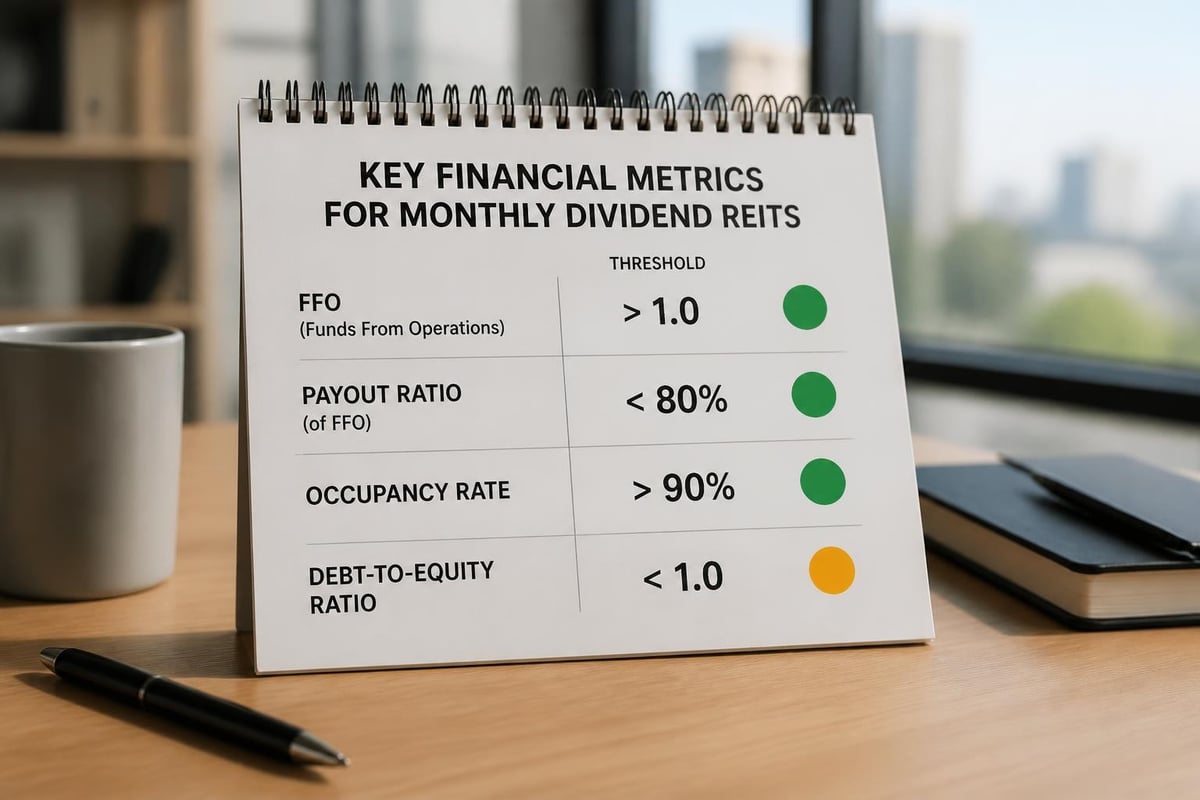
Look at these three things first:
- Funds From Operations (FFO) - REIT version of earnings
- Payout ratio - What percentage of FFO goes to dividends
- Occupancy rates - Empty buildings don't pay rent
If FFO is $2 per share and they pay $1.80 in dividends, that's a 90% payout ratio. Tight. Very little cushion.
75-80% is safer. Gives them room when tenants leave or rents drop.
Credit Ratings Matter
Moody's rates REIT creditworthiness based on leverage and cash flow stability.
Investment-grade rating (BBB or higher) means lower risk. Junk rating means watch out.
Monthly dividend continuity depends on financial strength. A REIT that can't refinance debt will cut dividends fast.
Tax Treatment of REIT Dividends
Here's the part nobody likes talking about.
REIT dividends are mostly ordinary income. That means your regular tax bracket, not the lower qualified dividend rate.
If you're in the 24% bracket, you lose 24% to taxes.
Qualified vs Non-Qualified
Some REIT dividends qualify for the 15-20% rate. But most don't.
The IRS Form 1099-DIV instructions explain how REITs report this. Box 1a shows ordinary dividends. Box 1b shows qualified.
Hold monthly dividend REITs in tax-advantaged accounts when possible. IRAs and 401(k)s shield you from annual tax hits.
Risks You Can't Ignore
Monthly payments sound great until they stop.
Rising interest rates hurt REITs. When bonds pay 5%, investors bail on 4% REIT yields. Share prices drop.
Property type matters too. Retail REITs took a beating when malls emptied out. Office REITs struggled during remote work shifts.
Dividend Cuts Happen
No dividend is guaranteed.
Companies cut when cash flow dries up. If a high yield monthly dividend REIT slashes payments by 30%, your monthly income just dropped hard.
Diversify. Don't put all your cash flow eggs in one monthly basket.
When Monthly Dividends Make Sense
You're retired and need predictable income. Monthly beats quarterly.
You're reinvesting and want faster compounding. Monthly beats quarterly.
You're living off portfolio income right now. Monthly matches your expense cycle better.
But if you're still working and don't need the cash flow, quarterly payers with lower yields and better growth might beat high yield monthly dividend REITs long-term.

Building a Monthly Income Portfolio
You don't need dozens of REITs.
Start with three to five solid monthly payers. Spread across property types. Maybe one retail, one industrial, one healthcare.
| Strategy | REIT Count | Diversification Level |
|---|---|---|
| Concentrated | 3-5 REITs | Sector-focused |
| Balanced | 6-10 REITs | Multi-sector |
| Diversified | 10+ REITs | Broad exposure |
Track your total monthly income. Add up all distributions. Make sure it covers what you need.
Real Estate Beyond REITs
Sometimes you need cash faster than dividend schedules allow.
If you're sitting on property you need to sell quickly, REITs won't help. You can't liquidate a building in 30 days without taking a bath on price.
That's where getting a cash offer makes more sense than waiting on monthly dividends. Direct property sales in Indiana, Georgia, or Tennessee can close in weeks, putting cash in hand now instead of collecting small checks over years.
Portfolio Rebalancing for Monthly Payers
Check holdings every quarter even though you get paid monthly.
Property values shift. One REIT might balloon to 40% of your portfolio while another shrinks to 10%.
Rebalance back to your targets. Sell some winners, buy some laggings. Keeps risk in check.
Don't chase yield bumps without checking why it jumped. A yield that suddenly hits 12% usually means the share price tanked because something's wrong.
High yield monthly dividend REITs deliver consistent cash flow when you pick stable properties with solid fundamentals and reasonable payout ratios. If you need immediate liquidity from real estate holdings instead of waiting on dividend payments, HudREI can provide a fair cash offer within 24 hours and close in as little as 3-4 weeks with no fees or repairs required across Indiana, Georgia, and Tennessee.