

Inherited Property Sale Process: Your Simple Guide
Selling an inherited house? Learn the inherited property sale process step-by-step, from probate to taxes to closing fast in 2026.
You just inherited a house. Now what?
The inherited property sale process feels overwhelming when you're already dealing with loss. But selling doesn't have to drag on for months. You need clear steps, not legal textbooks. Let's walk through exactly what happens when you sell an inherited home and how to move fast.
First Steps After You Inherit
You can't sell until you prove you own it. That's the biggest holdup most people hit.
The property passes through probate in most cases. That's the court process that transfers ownership from the deceased to you.
Some states let you skip probate if:
- The estate is small (usually under $50,000–$100,000)
- The property was in a trust
- It had transfer-on-death deeds
Check what happens to property after someone dies with your local probate court. They'll tell you if you need full probate or can use a shortcut.

During probate, the court names an executor or administrator. That person gets legal authority to handle the estate, including selling real estate.
No probate letter = no sale. The title company won't let you close without it.
Understanding the Mortgage Situation
Many inherited homes still carry a mortgage. You need to know what you owe before you list.
Contact the mortgage servicer right away. They'll tell you:
- Current loan balance
- Monthly payment amount
- Whether the loan is current or behind
Federal law protects you from immediate foreclosure. The Garn-St. Germain Act says lenders can't force the loan due just because you inherited the property.
But payments don't stop. Someone needs to cover them until you sell.
Your options:
- Keep paying until the house sells
- Assume the loan if you want to keep it
- Refinance in your own name
- Sell quickly and pay off the mortgage at closing
Many heirs choose to sell fast rather than juggle mortgage payments on a property they don't want to keep.
Getting Legal Authority to Sell
The inherited property sale process requires proper documentation. You can't just sign a purchase agreement because you're the heir.
The court issues Letters Testamentary (if there's a will) or Letters of Administration (if there isn't). This document proves you have authority to sell.
| Document Type | When You Get It | What It Does |
|---|---|---|
| Letters Testamentary | Executor named in will | Authorizes all estate actions |
| Letters of Administration | No will, court appoints | Same authority, different name |
| Small Estate Affidavit | Estate under state limit | Bypasses full probate |
Bring your court letters to the title company. They'll verify you can legally transfer the property.
Some states require court approval before you accept an offer. Ask the probate attorney handling the estate. Missing this step can kill your closing.
Tax Implications You Need to Know
The inherited property sale process comes with tax rules that actually work in your favor.
You get a stepped-up basis. That means the property's tax value resets to its worth on the date of death, not what the original owner paid.
Example: Your mom bought the house for $80,000 in 1995. It's worth $250,000 when she passes in 2026. Your basis is $250,000, not $80,000.
Sell for $250,000? Zero capital gains tax.
Sell for $260,000? You owe tax on $10,000 in gains.
The step-up rule saves most heirs thousands. It's explained in detail in IRS Publication 559 and the recent Kiplinger guide on inherited house taxes.
If multiple people inherited the house together, you each get your share of the basis. Selling and splitting proceeds is usually easier than co-owning long-term.

Preparing the Property for Sale
You have three paths:
- Sell as-is (no repairs, no cleaning, no staging)
- Light repairs (paint, carpet, minor fixes)
- Full renovation (gut the kitchen, new floors, everything)
Most heirs pick option one. They don't want to invest time and money into a house they're trying to leave behind.
As-is sales work when:
- The property needs major work
- You live out of state
- You need to close quickly
- You're splitting proceeds with siblings and can't agree on upgrades
Companies like HudREI buy inherited houses in Indiana, Georgia, and Tennessee in any condition. You skip repairs, showings, and months of waiting.
If you go the traditional route, you'll need to:
- Clear out personal belongings
- Handle estate sale or donation
- Deep clean the property
- Make minor repairs
- List with an agent
The inherited property sale process moves faster when the house is empty and ready to show.
Dealing With Multiple Heirs
Selling gets complicated when you're not the only heir.
Everyone who inherited a share must agree to sell. One holdout can stop the entire process.
Common sibling issues:
- One wants to keep the house, others want cash
- Disagreement on listing price
- Arguments over who gets what from the estate
- Different timelines (someone needs money now, others can wait)
Put everything in writing. Get all heirs to sign:
- Agreement to sell
- Choice of listing agent or buyer
- Minimum acceptable price
- How you'll split proceeds
If you can't agree, you might need a partition action. That's when the court forces the sale and divides the money. It's expensive and slow.
Better option: one heir buys out the others, or you accept a cash offer and split it equally.
Choosing How to Sell
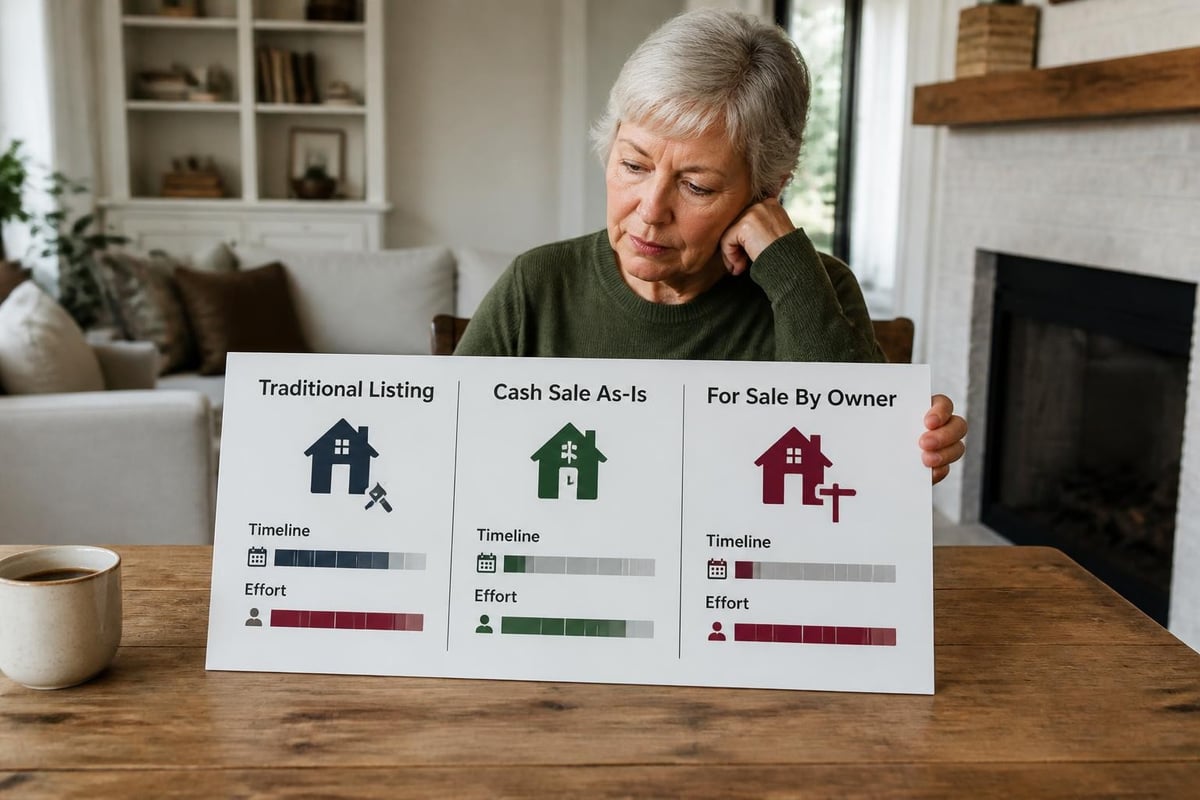
Traditional listing isn't your only option. The inherited property sale process gives you several paths.
Traditional Real Estate Agent
- Takes 2–6 months average
- You pay 5–6% commission
- House must show well
- You handle all showings and repairs
Cash Buyer
- Closes in 2–4 weeks
- No repairs needed
- No commission fees
- Lower price than retail
For Sale By Owner
- You save commission
- You handle all marketing, showings, paperwork
- Takes longer than using an agent
- Easy to make costly mistakes
Most people selling inherited homes want speed over top dollar. They're juggling probate deadlines, family dynamics, and often an empty house sitting vacant.
| Sale Method | Timeline | Cost | Effort Required |
|---|---|---|---|
| Agent listing | 2–6 months | 5–6% commission | High |
| Cash offer | 2–4 weeks | $0 fees | Minimal |
| FSBO | 3–8 months | Minimal | Very high |
The right choice depends on your situation, not what worked for someone else.
Handling the Closing
You made it to the finish line. The inherited property sale process ends at the closing table.
Bring your probate documentation. The title company needs:
- Letters Testamentary or Administration
- Death certificate (certified copy)
- Photo ID for all heirs signing
- Court order approving sale (if required in your state)
The title company handles:
- Paying off existing mortgage
- Clearing any liens or judgments
- Calculating prorated property taxes
- Distributing proceeds to heirs
You'll sign the deed and transfer ownership to the buyer. Wire transfers happen same day or next business day.
If multiple heirs are selling, each person must sign unless one has power of attorney for the others.
Common Closing Issues
Problems that pop up at the last minute:
- Title defects (old liens, boundary disputes, missing signatures from previous sales)
- Probate not complete (court hasn't issued final order)
- Missing heir signatures (someone didn't sign the deed)
- Tax liens (IRS or state has claim on the property)
Most issues get resolved within days. Your title company will tell you exactly what they need.
Keep all heirs in the loop. Surprises at closing create delays.
Managing Proceeds and Taxes
The money hits your account. Now what?
If the estate owes debts, those get paid first. The executor uses sale proceeds to cover:
- Funeral costs
- Medical bills
- Credit card debt
- Legal fees
Remaining proceeds go to heirs according to the will or state law.
You'll receive a 1099-S form if your gain exceeds reporting thresholds. File it with your tax return for the year you sold.
Most heirs owe little or no tax thanks to stepped-up basis. But run the numbers with a tax pro to be sure. The IRS guidance on home sale taxes explains what you need to report.
Each heir reports their share of any gain on their personal return. The estate doesn't pay capital gains tax on real estate sold during probate settlement.
What If You Want to Keep It
Not everyone sells right away. Some heirs want to keep the inherited property.
Your options:
- Move in as your primary residence
- Rent it out for income
- Buy out other heirs if you co-inherited
- Hold it as an investment
Consider the costs:
- Mortgage payments (if any)
- Property taxes
- Insurance
- Maintenance and repairs
- HOA fees
Can you afford those monthly? Will the property appreciate enough to justify keeping it?
Many heirs try to keep the family home, then realize the financial burden is too much. It's okay to change your mind and sell later.
The inherited property sale process is still available whenever you're ready.
Selling an inherited house doesn't have to take months of stress and expense. Once you understand the inherited property sale process, you can move forward with confidence and close this chapter quickly. If you're ready to sell your inherited property in Indiana, Georgia, or Tennessee without repairs, fees, or waiting, HudREI can give you a fair cash offer in 24 hours and close in as little as three weeks.